A group of Caltech undergraduates will see their lab work launched to the International Space Station in spring 2027, after spending two terms designing and building scientific instruments on the Pasadena campus.
The students are enrolled in EE 154ab, "Practical Electronics for Space Applications," a two-term course taught every other year by Andy Klesh, a lecturer in electrical engineering who also serves as associate director and chief systems engineer of the Caltech/JPL Brinson Exploration Hub. Klesh led JPL's 2018 MarCO dual-spacecraft CubeSat mission to Mars and the Lunar Trailblazer orbiter before joining Caltech's teaching faculty.
For the 2025-26 course, Caltech and JPL partnered with the National Geographic Society's Explorers program through the Brinson Exploration Hub, according to Caltech Magazine. The collaboration gave students a real client: National Geographic Explorers who collected microscopic organisms from ecosystems in Thailand, Zambia, and the United States. The student-built instruments will carry those samples to the ISS so biologists can study how the organisms respond to microgravity and radiation.
Klesh told Caltech Magazine that the second term gave students real payload requirements from the National Geographic Society, a step beyond the course's traditional balloon-launch exercise.
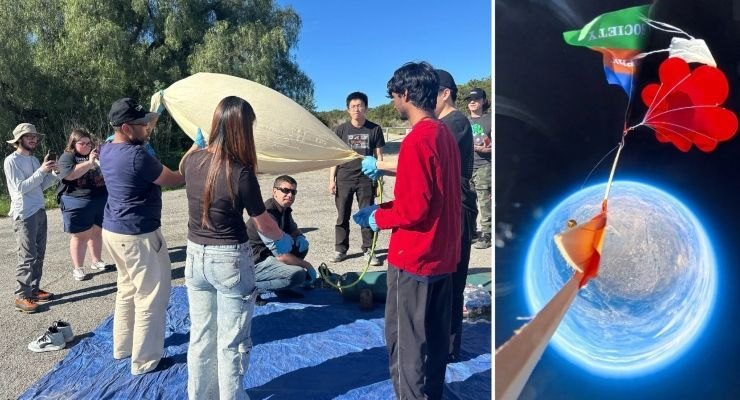
The first term followed the course's familiar format. Students built subsystems and launched them aboard a high-altitude balloon on Saturday, February 28, 2026. The balloon climbed to nearly 100,000 feet before descending roughly 200 kilometers away in the California desert. Students spent the rest of that day tracking and recovering their hardware.
First-year mechanical engineering major Vishal Yalla served as flight director for the balloon mission. "We weren't given a launch time," Yalla told Caltech Magazine. "We had to evaluate weather conditions, predict the balloon's trajectory, coordinate recovery logistics, secure permissions, and make sure we complied with all FAA regulations among many other details. This is the real world."
The second term gave students nine weeks to design, build, and test space-ready cameras, sensors, and other payloads. The class organized into five subgroups, each tackling a different engineering problem. Third-year electrical engineering major Jeylin Lee worked on the thermal team, whose chief challenge was maintaining constant temperature in the vacuum of space. Second-year Daniel Wareham focused on integrating a 360-degree camera and testing whether it could survive extreme cold.
In previous iterations, Klesh programmed an "antagonistic payload" that deliberately caused data errors, interference, and overheating to simulate real spacecraft failures. This year, the actual mission requirements provided enough difficulty on their own.
Final assembly before the 2027 launch will take place in the Resnick Sustainability Center's clean room on Caltech's campus. The spring 2026 term concluded with a design review in which students presented their builds to NASA and the National Geographic Society to confirm readiness before the SpaceX launch.
The course is listed in Caltech's catalog at technology readiness levels 3 through 5, bridging the gap between laboratory proof-of-concept and hardware tested in a relevant environment. EE 154ab will next be offered during the 2027-28 academic year.