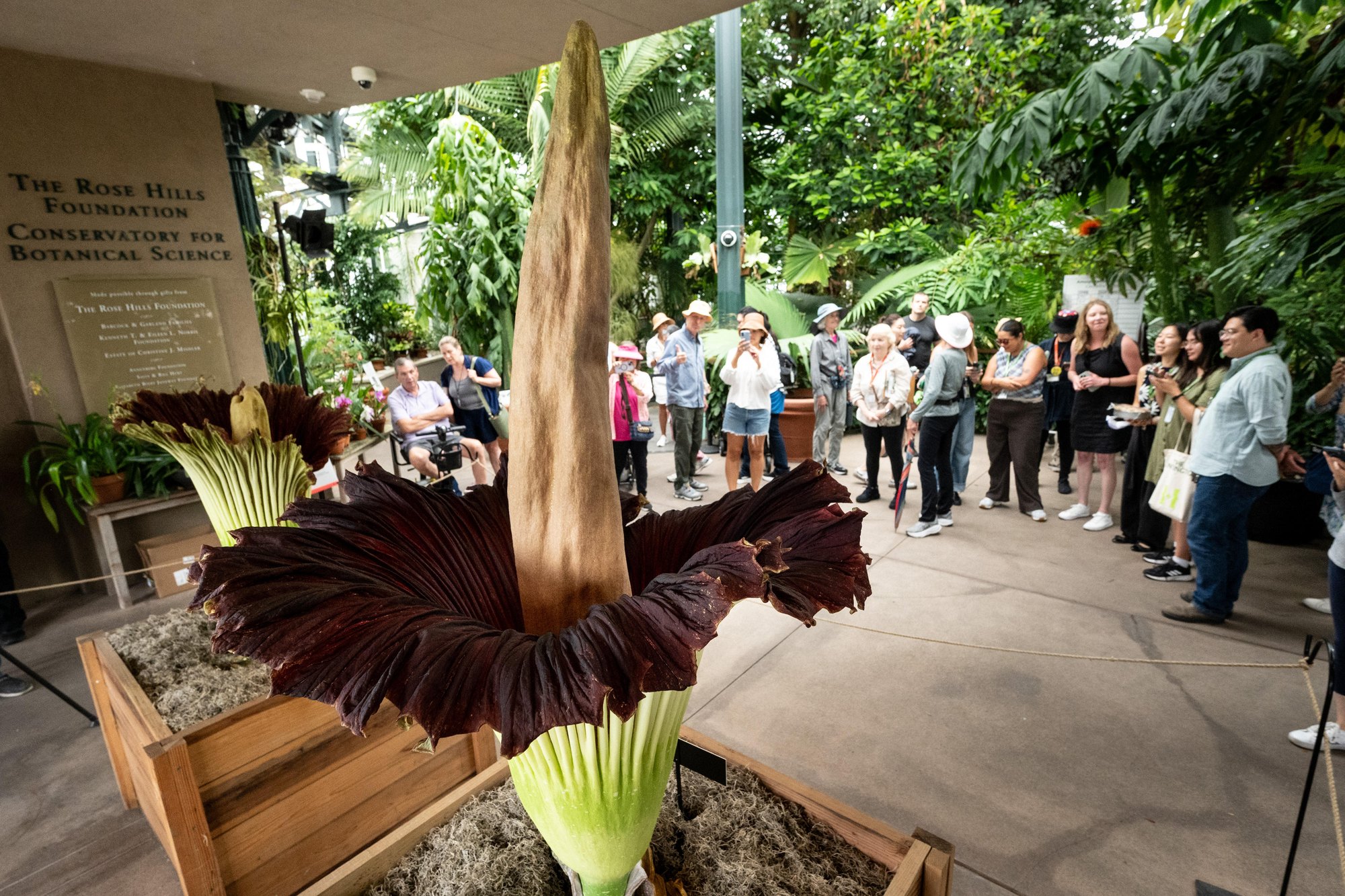
More than 5,700 people reserved tickets by early Monday morning to smell two corpse flowers blooming simultaneously at The Huntington in San Marino, more than double the garden's typical summer weekday crowd of about 2,500.
The sibling Titan Arum plants, nicknamed Odorysseus and Odora, began unfurling Sunday afternoon, July 12, at the Rose Hills Foundation Conservatory for Botanical Science. Odorysseus opened first; Odora followed just hours later. Their stench peaked around 2 a.m. Monday, July 13, filling the conservatory with the rotting-flesh odor that gives the species its common name.
"The double bloom this summer was definitely a surprise," said Brandon Tam, associate curator of orchids at The Huntington. "We knew that Odorysseus was going to bloom probably Sunday. But what surprised us was that we saw that Odora was opening just a few hours after."
Tam said Southern California's recent high humidity likely triggered both plants to unfurl at once. The last time multiple corpse flowers bloomed on the same day at The Huntington was in 2018.
At 71 inches tall, Odorysseus towered over its sibling. Odora measured 41 inches because its spadix, the central column, inverted during development. Tam called it a developmental irregularity but said the plant is healthy and will look normal when it reblooms in three to four years. The bloom marked Odorysseus' public debut; Odora last bloomed in 2024.
The crowds matched the spectacle. By 8:51 a.m. Monday, reservations had already surpassed 5,700, exceeding the roughly 4,900 who visited during last year's single bloom, according to Keisha Raines, The Huntington's assistant director of news and media relations. Parking lots inside the grounds filled quickly, pushing some visitors to park on surrounding streets.
Ollie, a 13-year-old plant enthusiast visiting with family, said they were glad to finally catch a bloom in person. "Even more than the smell, it's just a really beautiful presence and it's really large," Ollie said.
Orchid specialist Erik de Leon noted one unusual guest: a taxidermist who brought flesh-eating beetles that were drawn to the scent.
The Titan Arum is native to the rainforests of western Sumatra, Indonesia, and is classified as endangered. It is not a single flower but a massive structure composed of hundreds of smaller male and female blooms at its base. The Huntington maintains more than 43 mature specimens and has exhibited 29 corpse flower blooms since 1999, more than any other institution in the western United States. Staff hand-pollinate the plants during flowering and share seeds and corms with partner gardens to help preserve the species.
The peak bloom has passed, but the post-bloom display remains viewable through approximately Sunday, July 19. The Huntington is open daily 10 a.m. to 5 p.m., closed Tuesdays, at 1151 Oxford Road, San Marino. General admission includes access. A 24-hour livestream is available at huntington.org/corpse-flower.