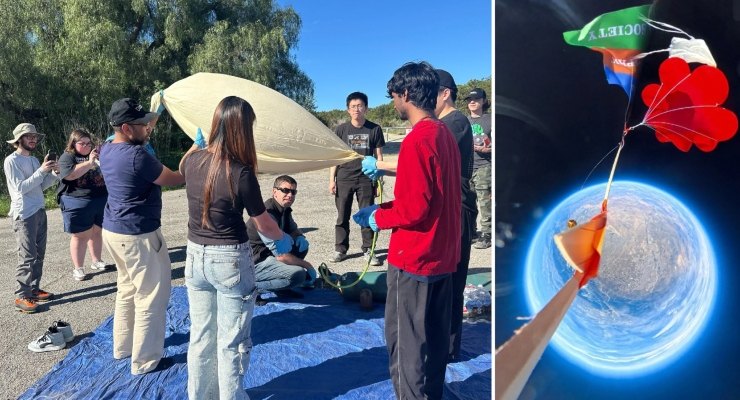
Instruments built by Caltech undergraduates in a Pasadena lab will ride a SpaceX rocket to the International Space Station in a launch scheduled for spring 2027, marking the first time a Caltech course has produced hardware for an orbital spaceflight mission.
The students are enrolled in EE 154ab, "Practical Electronics for Space Applications," an electrical engineering course offered every two years and taught by Andy Klesh. Klesh is the inaugural associate director and chief systems engineer of Caltech's Brinson Exploration Hub and a JPL veteran who served as lead engineer on the 2018 MarCO dual-spacecraft mission to Mars and the Lunar Trailblazer orbiter.
For the 2025-26 course, Caltech and JPL partnered with the National Geographic Society's Explorers program through the Brinson Exploration Hub, which was inaugurated in early 2024 with a $100 million gift from the Brinson Foundation. The student payloads will carry samples of microscopic organisms collected from ecosystems in Thailand, Zambia, and the United States by National Geographic Explorers. Those ecologists and biologists plan to study biological resilience under microgravity and radiation aboard the station.
The class runs two terms. During winter 2026, students built instruments and launched them on a high-altitude balloon on Saturday, February 28, 2026. The balloon ascended into the stratosphere before descending roughly 200 kilometers inland across the California desert, where students spent the rest of the day recovering it.
"We weren't given a launch time," said Vishal Yalla, a first-year mechanical engineering and aerospace major who served as flight director for the balloon mission. "We had to evaluate weather conditions, predict the balloon's trajectory, coordinate recovery logistics, secure permissions, and make sure we complied with all FAA regulations among many other details. This is the real world."
In the nine-week spring 2026 term, five subgroups tackled distinct payload problems. Jeylin Lee, a third-year electrical engineering major with an astrophysics minor, works on the thermal team, which must keep instruments at a constant temperature in the vacuum of space where convection doesn't exist. Daniel Wareham, a second-year student, integrated a 360-degree camera for the balloon flight and is now helping bring the subgroups' work together for the final build.
In previous years, Klesh programmed an "antagonistic payload" that deliberately introduced data errors, interference, and overheating to simulate real spacecraft failures. This year, he didn't need it. The actual ISS mission requirements provided enough challenge on their own.
The course will conclude with a design review in which students present their builds to NASA and the National Geographic Society. Some final assembly will happen in the Resnick Sustainability Center's clean room on the Caltech campus in Pasadena.
Klesh, who also volunteers with the Pasadena Fire Department as an EMT, said the two-term structure gave students a concrete progression: they planned and executed a balloon flight, then carried that knowledge into the second term where National Geographic provided the payload requirements for the station mission. The spring 2027 SpaceX launch date was reported by Caltech Magazine on June 29, 2026.