The Jet Propulsion Laboratory is turning 90, and Pasadena's most famous research campus has three new space missions lined up for launch in 2027 and 2028.
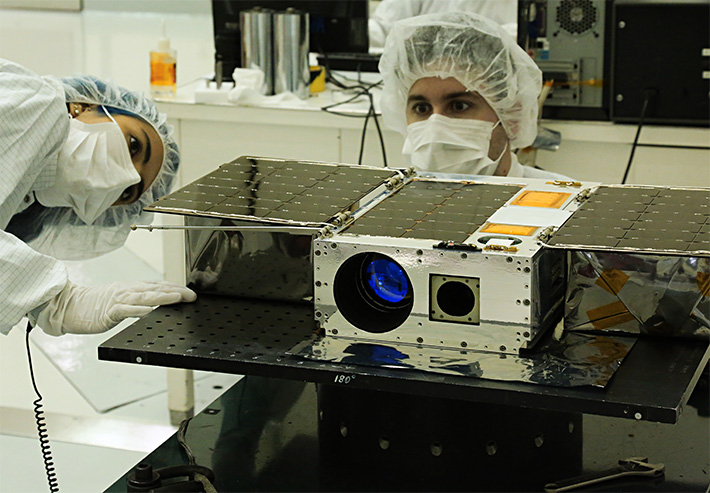
JPL Director Dave Gallagher, who has led the lab since 2025, outlined the upcoming slate in a NASA announcement marking the anniversary. SunRISE (Sun Radio Interferometer Space Experiment), a set of six toaster-oven-size satellites, is targeting a 2027 launch. The satellites will fly in formation to create a miles-wide radio antenna for studying the sun's activity. What it reveals could help make space exploration safer for humans.
SkyFall, aiming for 2028, will deploy three helicopters during descent over Mars to search for hidden ice deposits and analyze weather patterns. That same year, MoonFall plans to land a group of large propulsive drones at the lunar south pole to help advance NASA's Moon Base.
"Over the course of 90 years, JPL's first-of-a-kind missions have transformed our understanding of the universe and our place in it," Gallagher said in the announcement.
Gallagher joined JPL as an engineer in the early 1990s. He led the team that built and tested the Wide-Field and Planetary 2 Camera for NASA's Hubble Space Telescope, which produced many of the mission's most recognized images.
The anniversary traces to Oct. 31, 1936, when a group of Caltech graduate students and enthusiasts fired rockets in Pasadena's Arroyo Seco. That work became the foundation for JPL, now managed by Caltech for NASA. The lab launched America's first satellite, Explorer 1, in 1958. It sent the first U.S. mission to the moon in 1964, led the first planetary flyby and put the first rovers and the first rotorcraft on Mars.
Caltech President Ray Jayawardhana, also a professor of astronomy, said in the announcement that the partnership between Caltech and JPL continues to advance NASA's priorities. He said the same spirit of daring that drove those early rocket experiments is still opening new frontiers.
A near-term milestone arrives Wednesday, Nov. 18, when Voyager 1 reaches one full light-day from Earth. That's about 16 billion miles, the distance light travels in 24 hours. NASA said the spacecraft will hit the mark at 5:16:07 a.m. EST after traveling for 49 years, two months and 11 days since its 1977 launch. No other human-made object has reached that distance.
Its twin, Voyager 2, which took a different path to visit Uranus and Neptune, is on pace to reach one light-day from Earth in November 2035.
The late Ed Stone, who served as Voyager's project scientist for 50 years and as JPL's director from 1991 to 2001, died in June 2024 at age 88. Both Voyager probes continue exploring interstellar space, relying on NASA's Deep Space Network, which JPL developed during the Apollo era, to send and receive data.
JPL also manages NEO Surveyor (Near-Earth Object Surveyor), a mission to hunt for potentially hazardous asteroids that other telescopes cannot find, and is working on Earth-observation missions tracking water movement, tropical storm formation and air pollution's effects on human health.