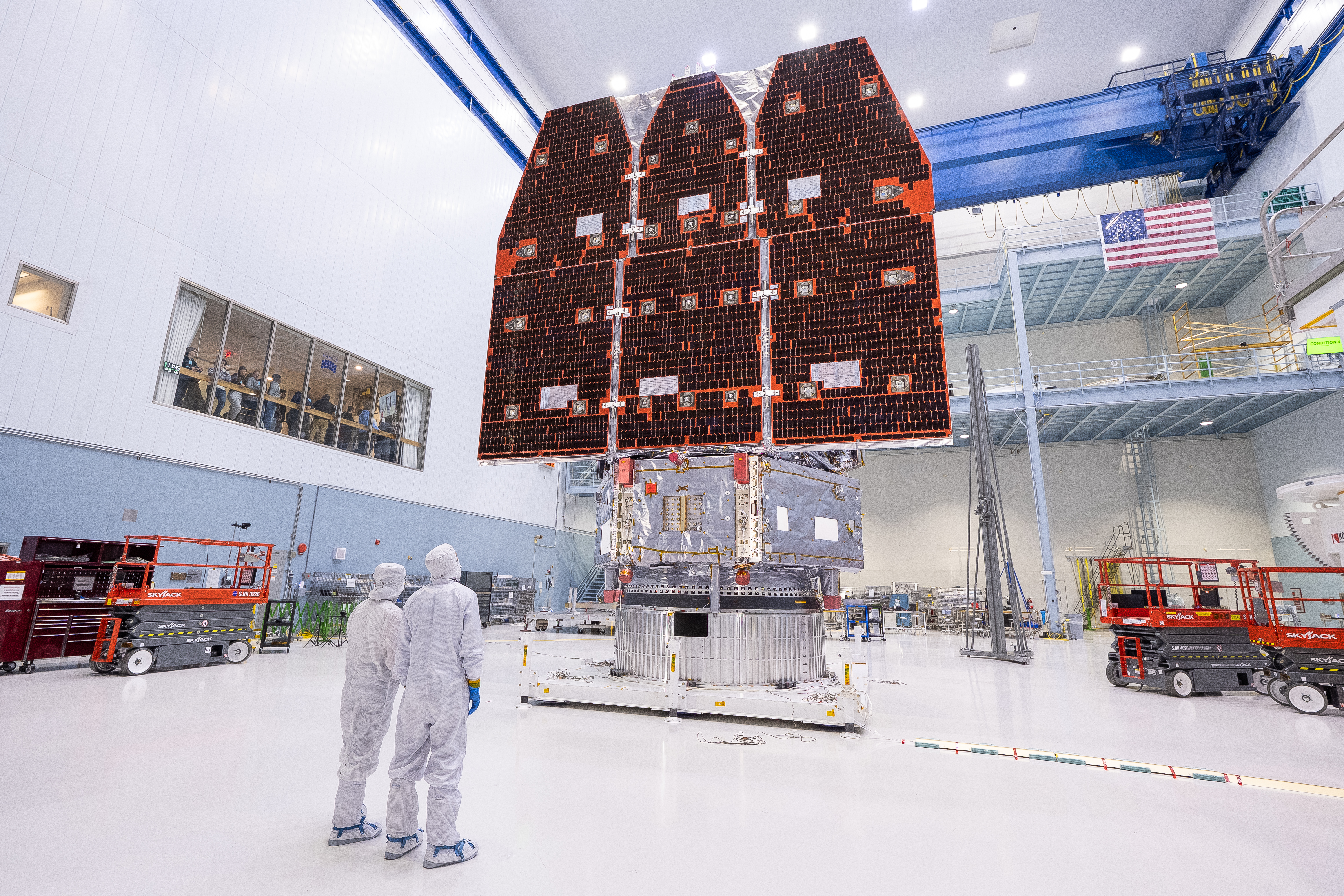
Pasadena families can walk into Caltech's Cahill Center for Astronomy and Astrophysics on Friday evening, July 24, and hear directly from a scientist helping run one of NASA's most ambitious missions, weeks before it launches.
Lee Armus, a senior research scientist at Caltech's Infrared Processing and Analysis Center, will present "The Roman Space Telescope: NASA's Next Great Observatory" as part of the university's free Stargazing Lectures series. The talk begins at 8 p.m. at 1216 E. California Blvd.
Armus serves as lead scientist for the Roman Space Telescope's Science Support Center at IPAC, which will handle data processing for the mission's spectroscopy observations. Pasadena, in other words, will be one of the nerve centers for the telescope's science operations once it reaches orbit.
What the telescope will do
The Nancy Grace Roman Space Telescope, named for NASA's first chief of astronomy, carries a field of view more than 100 times larger than the Hubble Space Telescope's while maintaining comparable image sharpness. NASA says it will study up to a billion galaxies over its lifetime, searching for exoplanets, mapping dark matter, investigating dark energy, and tracing how galaxies formed and evolved.
NASA is targeting no earlier than Sunday, Aug. 30, for launch on a SpaceX Falcon Heavy rocket from Kennedy Space Center. The telescope arrived at Kennedy on June 21 aboard NASA's Pegasus barge and is undergoing pre-launch processing. According to the agency, the launch comes roughly nine months ahead of the original schedule.
In a 2021 Space Telescope Science Institute news release about Roman's capabilities, Armus described the scope of the mission: "Using Roman we can estimate how fast galaxies are making stars and find the most prolific galaxies that are producing stars at an enormous rate. More importantly, we can find out not only what's happening in a galaxy at the moment we observe it, but what its history has been."
How the evening works
The lecture runs from 8 to 8:45 p.m., according to Caltech's event listing. A panel Q&A and guided stargazing with telescopes follow from 8:45 to 9:45 p.m. The stargazing portion is weather-dependent; the lecture and Q&A proceed rain or shine.
No reservations are needed. Children are welcome. The series is pitched at a layperson level, no science background required.
For those who can't make it in person, the lecture and Q&A will be livestreamed on YouTube.
Directions and weather updates are available at outreach.astro.caltech.edu.